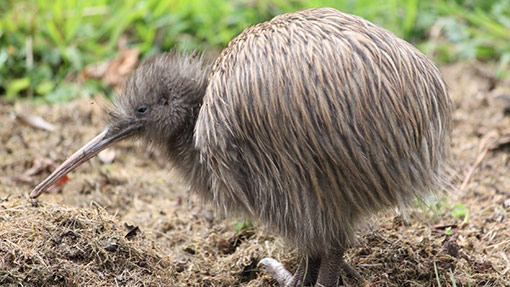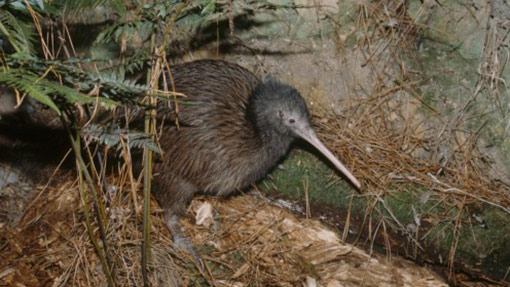
Early in 2025, Save the Kiwi conducted a comprehensive survey to understand the health of the North Island brown kiwi living on Te Kawau Tūmaro-o-Toi Kawau Island. The unique genetic history of these kiwi, the presence of wallabies, and habitat degradation indicate the need for a vegetation restoration and a future genetic management.
The team surveyed the island between January and March 2025 on behalf of Auckland Council. The survey, utilising kiwi detection dogs, is the first to directly assess the health, structure and genetics of kiwi on the island. Before this survey, more than three decades of listening surveys, acoustic recorders and a thermal camera study, confirmed that kiwi were present on Kawau, but did not provide a comprehensive understanding of the state of the population.
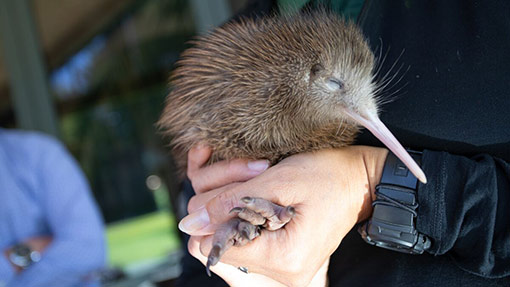
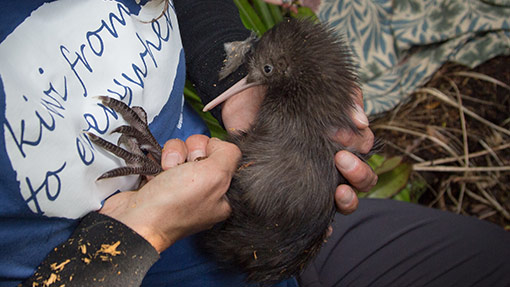
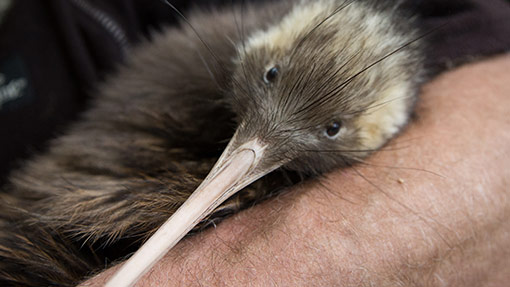
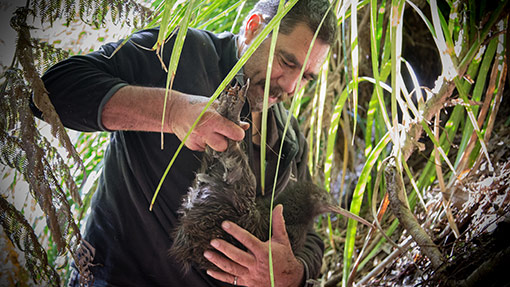
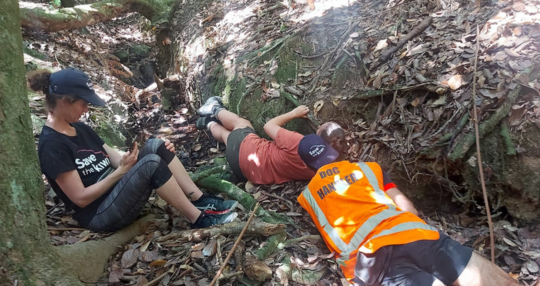
Across three survey trips, trained kiwi dogs detected 56 birds, with 51 kiwi safely handled by the team. All were adults, many in moderate to poor body condition, and with no chicks or juveniles found.
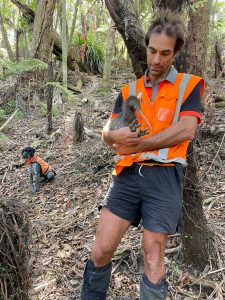
Tom Donovan and kiwi dog Kimihia. Photo credit: Emma Craig
The absence of young birds during the survey suggests that, in the recent years, the population has had low reproductive success and minimal recruitment into the adult population. Dry environmental conditions, habitat degradation and heavy browsing of the forest undergrowth by wallabies are all likely contributing factors, reducing food availability and putting pressure on adult birds.
The kiwi on the island are believed to trace back to a small number of birds translocated from Hokianga in the 1860s by Governor Grey, with possible additional introductions from the Coromandel decades later. Genetic sampling has revealed Kawau kiwi have very low genetic diversity, with many individuals closely related. While some unique genetic traits were found, long-term isolation raises concerns about in-breeding and resilience.
Tineke Joustra, Operations Manager of Save the Kiwi says the kiwi on Kawau Island are a particularly special population with their unique genetic history.
“Our recent survey shows the population is healthy, but that its long-term resilience would benefit from a carefully managed genetic exchange. That means creating space by moving some birds to other suitable sites, while bringing new genetics onto the island at the same time.”
“With the wallaby eradication currently underway, we’re also looking forward to the undergrowth regenerating and hope this improved habitat will support higher chick survival and, over time, more young birds on the island.”
“This research allows us to plan smarter, look at habitat improvement, wallaby control and carefully managed translocations to strengthen the population while also protecting its unique genetics.”
Auckland Council’s Project Manager Lisa Tolich says the survey gives essential baseline information that simply wasn’t available before.
“Following our recent forest ecosystem monitoring work, the North Island brown kiwi health and demographic survey on Kawau Island has provided valuable insights. It helps us understand how habitat condition and pests are affecting kiwi and it will guide future habitat restoration and management priorities.”
The survey was carried out under the Wildlife Authority of Save the Kiwi with support from Ngāti Manuhiri and funded by Auckland Council’s Natural Environment Targeted Rate. Regular monitoring and integrated genetic planning are now recommended, positioning Kawau Island to play a meaningful role in the wider recovery of kiwi across New Zealand.
The full survey report can be found here.